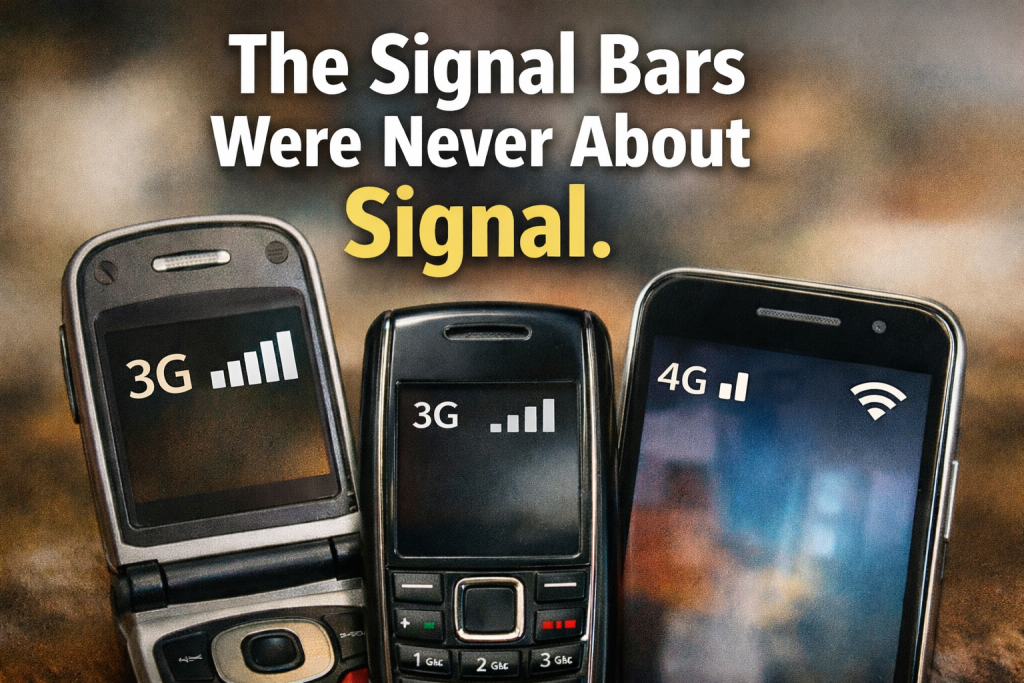
I still remember when anything less than full bars was a crisis.
I can’t tell you how many customers came to me angry that their phone only showed four bars. Four meant something was wrong. Four meant calls were about to drop. Four meant the network was failing them.
What made it worse was that the very next customer would walk in, look at their phone, see four bars… and feel completely fine.
And here’s the funny part: some phones didn’t even have five bars to show. Some only showed four. Older ones showed three. Yet somehow, people still treated their own display as an absolute measure of truth.
People took their signal bars personally.
A dropped call? Must be the bars.
A garbled call? Bars.
A call that never connected? Definitely bars.
In reality, most of those problems had nothing to do with signal strength. They were capacity issues. Switching problems. Congestion deep in the network – far away from the phone in your hand.
But none of that was visible.
The bars were.
Even then, the bars weren’t consistent. Different brands used different scales. Different models from the same brand behaved differently. Five bars on one phone didn’t mean the same thing on another.
Some devices didn’t even pretend to explain themselves. Some early cellular devices had a single LED – red or green, solid or flashing. It meant… something. Nobody really knew what.
Over time, the industry tried to get “smarter.” More granularity. More nuance. More logos and small letters: 1x, 3G, EVDO, EDGE, LTE, 4G, 5G, and a slew of add-ons.
It looks technical.
It feels authoritative.
But it still doesn’t tell most people what they actually want to know.
Can I make a call?
Will this work when I need it?
Here’s the uncomfortable truth: a good signal was never a peak. It was always a range. Too weak is bad, but too strong can be bad too. And none of that nuance survives being flattened into bars.
The bars were never about precision.
They were about reassurance.
And not just reassurance for you.
They reassured carriers.
They reassured handset manufacturers.
They reassured chipset vendors and engineers.
They reduced complaints.
They shifted blame.
They controlled the narrative.
The bars weren’t there to tell you the truth about your connection. They were there to make you feel like everything was fine, even when the real problems lived somewhere you couldn’t see.
At some point, that reassurance stopped being about the customer at all. It was about liability, it was about competition and being the best in the business. It became… MARKETING. Shareholder perception. Stock value. Competitive optics.
𝘐𝘯 𝘗𝘢𝘳𝘵 2: 𝘸𝘩𝘦𝘯 𝘴𝘪𝘨𝘯𝘢𝘭 𝘣𝘢𝘳𝘴 𝘤𝘳𝘰𝘴𝘴𝘦𝘥 𝘵𝘩𝘦 𝘭𝘪𝘯𝘦 𝘧𝘳𝘰𝘮 𝘢𝘣𝘴𝘵𝘳𝘢𝘤𝘵𝘪𝘰𝘯 𝘵𝘰 𝘰𝘱𝘵𝘪𝘤𝘴, 𝘢𝘯𝘥 𝘩𝘰𝘸 𝘢𝘯 𝘦𝘯𝘵𝘪𝘳𝘦 𝘪𝘯𝘥𝘶𝘴𝘵𝘳𝘺 𝘲𝘶𝘪𝘦𝘵𝘭𝘺 𝘢𝘨𝘳𝘦𝘦𝘥 𝘵𝘰 𝘭𝘦𝘵 𝘺𝘰𝘶 𝘣𝘦𝘭𝘪𝘦𝘷𝘦 𝘴𝘰𝘮𝘦𝘵𝘩𝘪𝘯𝘨 𝘵𝘩𝘢𝘵 𝘸𝘢𝘴𝘯’𝘵 𝘵𝘳𝘶𝘦.
Originally posted on LinkedIn